Trussium Architecture
Status: Draft
This document describes the architectural vision for Trussium. It serves as the primary technical reference for the project and guides implementation decisions as the platform evolves.
Overview
Trussium is a cloud-native runtime for AI applications.
Its primary responsibility is to provide a consistent execution layer between AI applications and the rapidly evolving ecosystem of AI providers, protocols, tools, and deployment platforms.
Applications integrate with Trussium once.
Trussium manages communication with providers, execution of capabilities, routing, observability, and future extensions.
Architectural Principles
The architecture is guided by the following principles:
- Cloud-native by design
- Provider agnostic
- Capability first
- Protocol agnostic
- Extensible through plugins
- Observable by default
- Secure by default
- API-first
- Backwards-compatible public interfaces
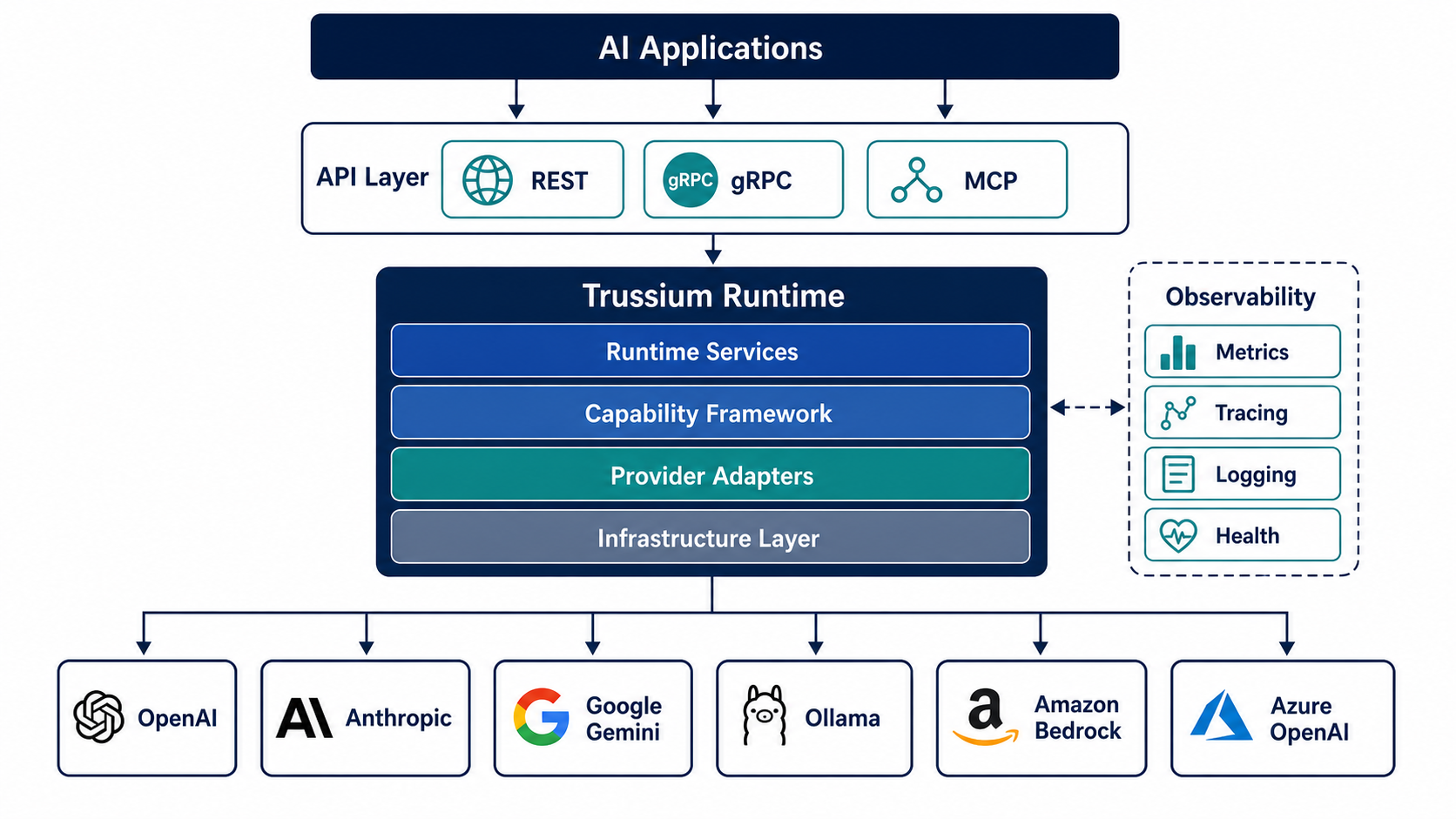
High-Level Architecture
                    AI Applications
                           │
        REST        gRPC        MCP
             \        │        /
              \       │       /
               Trussium Runtime
                      │
              Runtime Services
                      │
             Capability Framework
                      │
              Provider Adapters
                      │
  OpenAI • Anthropic • Gemini • Ollama • ...
The runtime is responsible for orchestrating requests while remaining independent of provider-specific implementations.
Runtime Layers
The runtime is organized into logical layers.
┌────────────────────────────────────┐
│           API Layer                │
├────────────────────────────────────┤
│         Runtime Services           │
├────────────────────────────────────┤
│      Capability Framework          │
├────────────────────────────────────┤
│       Provider Adapters            │
├────────────────────────────────────┤
│      Infrastructure Layer          │
└────────────────────────────────────┘
Each layer has a clearly defined responsibility and communicates only with adjacent layers.
API Layer
The API layer exposes Trussium through multiple protocols.
Supported interfaces include:
- REST
- gRPC
- Model Context Protocol (MCP)
Future protocols can be added without modifying the runtime.
Runtime Services
Runtime Services coordinate request execution.
Responsibilities include:
- Request orchestration
- Authentication
- Authorization
- Routing
- Retry policies
- Failover
- Rate limiting
- Streaming
- Request lifecycle management
Runtime Services are provider independent.
Capability Framework
The Capability Framework defines what Trussium can execute.
Examples include:
- Chat
- Embeddings
- Image Generation
- Audio
- Video
- Realtime
- Tool Execution
- Agents
Capabilities define the runtime contract.
Providers implement capabilities.
Application composition registers provider-neutral implementations under
validated stable capability names. A sealed insertion-ordered registry owns
local lookup and immutable discovery, while protocol-specific execution remains
behind capability interfaces. The REST API resolves chat.completions through
that registry rather than a dedicated provider attribute. Bounded immutable
metadata travels with registrations and powers the ordered read-only
GET /v1/capabilities discovery view without exposing implementations,
providers, models, health, or availability.
A separate reporter binds to the sealed source registry and gives every
registration an informational availability state. Optional capability checks
run concurrently within a dedicated deadline and feed the ordered
GET /v1/capabilities/availability view without gating execution, liveness, or
readiness.
One application-owned execution pipeline sits on top of the sealed registry. It resolves canonical names once, binds immutable execution context across non-streaming and streaming work, preserves capability-specific results and failures, and finalizes upstream streams. The existing chat REST path uses this boundary without moving transport, logging, tracing, timeout, or provider semantics into the pipeline.
An immutable ordered middleware snapshot surrounds that execution boundary. Each provider-neutral layer receives frozen resolved invocation metadata and a single-use continuation for asynchronous or streaming work. Declaration-order entry, reverse unwind, short-circuiting, context propagation, and pipeline-owned stream cleanup are shared across capability interfaces. Lifecycle management, availability reporting, health, routing, provider registration, and dynamic plugins remain separate framework layers.
Provider Adapters
Provider adapters translate runtime requests into provider-specific APIs.
Examples include:
- OpenAI
- Anthropic
- Google Gemini
- Ollama
- Amazon Bedrock
- Azure OpenAI
Adapters isolate provider-specific behavior from the rest of the runtime.
Infrastructure Layer
Infrastructure components support the runtime.
Responsibilities include:
- Configuration
- Logging
- Metrics
- Tracing
- Secrets
- Dependency injection
- Lifecycle management
These components remain independent of runtime capabilities.
Request Lifecycle
Every request follows a consistent execution pipeline.
Client
   │
API Layer
   │
Authentication
   │
Authorization
   │
Routing
   │
Capability Framework
   │
Provider Adapter
   │
AI Provider
   │
Response
This lifecycle remains consistent regardless of provider or protocol.
Plugin Architecture
Trussium is designed to be extensible.
Extension points include:
- Providers
- Capabilities
- Middleware
- Routing strategies
- Authentication
- Authorization
- Observability
Plugins should be discoverable without modifying the runtime.
Repository Strategy
The Trussium project consists of multiple repositories.
Trussium
│
├── trussium
├── trussiumctl
├── trussium-helm
├── trussium-operator
├── trussiumhq.github.io
├── trussium-sdk-python
├── trussium-sdk-go
├── trussium-sdk-typescript
├── trussium-provider-vllm
├── trussium-provider-anthropic
├── trussium-provider-libretranslate
└── trussium-provider-piper
Each repository has a clearly defined responsibility and independent release cadence. The runtime is the core Python platform; Helm and the operator own Kubernetes packaging and lifecycle management; the documentation site publishes assembled project docs; SDKs provide language-specific clients; and provider repositories contain optional adapters that translate external APIs into the runtime's provider-neutral contracts.
trussiumctl is the standalone Go platform CLI. It coordinates Kubernetes and
Helm operations through documented APIs and published artifacts; it does not
embed runtime execution or provider SDKs.
Technology Strategy
Languages are selected based on the responsibilities of each component.
| Component | Language |
|---|---|
| Runtime | Python |
| Runtime CLI | Python |
Platform CLI (trussiumctl) |
Go |
| Kubernetes Operator | Go |
| SDK (Python) | Python |
| SDK (Go) | Go |
| SDK (TypeScript) | TypeScript |
Each language is chosen to best suit the operational characteristics of the component.
Deployment Model
Trussium is designed to run in multiple environments.
- Local development
- Docker
- Kubernetes
- Managed cloud platforms
The runtime should behave consistently across all supported deployment environments.
Design Philosophy
The architecture favors stable abstractions over provider-specific implementations.
Provider APIs will continue to evolve.
New protocols will emerge.
New AI capabilities will be introduced.
The runtime should absorb ecosystem changes without requiring applications to change.
Applications integrate once.
Trussium evolves behind the interface.